Lagos currently has a BRT Lite system in place that started operation in 2008 (Otunola 3). This is essentially a government run bus system that was planned and put into place by LAMATA. These buses run on partially segregated lanes, and have higher standards for safety as well as lower fares than danfo minibuses (Otunola 15). This makes them more accessible to citizens of Lagos.
LAMATA’s plan is to incrementally develop this system until danfo minibuses can be completely phased out. The BRT Lite system is not a fully efficient system (unlike the BRT system detailed in the figure below), but it fulfills its purpose to deliver small changes and developments rapidly. Relatively cheap and time efficient improvements are much easier to make through a bus system than through a rail system, because the infrastructure required to start isn’t as advanced.
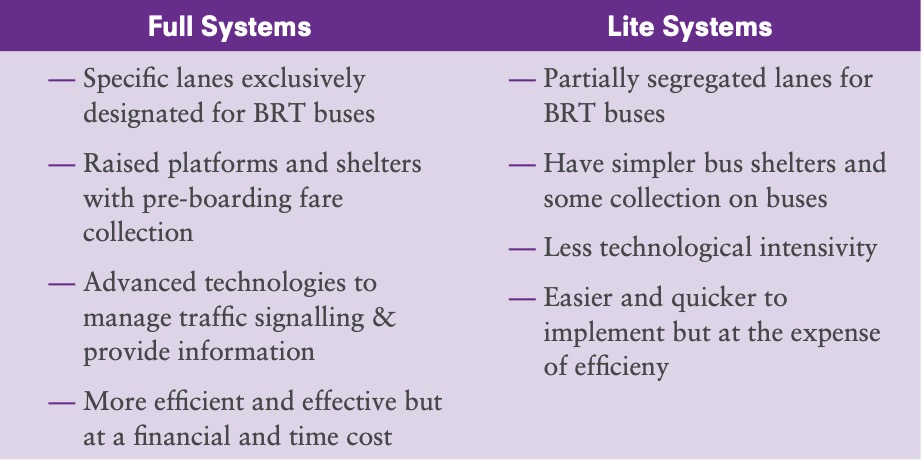
A case study of Lagos’ transport reforms from 1999-2019, by Otunola et. al, IGC Cities that Work Case Study, 2019, p. 6.
Evidently, the plan to phase out minibuses and replace them all with BRT buses hasn’t come to pass, and this is largely due to the rapid increase in Lagos’ population. Previous government attempts at bus systems have also tried to phase out private operators, but have run into the same issue. In the early 1960’s the state owned Lagos Municipal Transport Service (LMTS) attempted to grow at a rate that would allow them to replace all the private bus operators, but even at a six percent increase in buses per year, the population kept growing faster (Olukoju).
Private operations have never been completely eliminated in Lagos, because there’s just no way that everybody in the city would be accounted for. The BRT also doesn’t service all the suburbs of Lagos, and although it expands continuously, the trends seem to point to the metropolitan area of Lagos expanding at an even faster rate, making totally phasing out danfos and other private services impossible. But expanding the BRT is still LAMATA’s main goal at this point, although the public might not agree with this approach.
Although the BRT might not be the most effective solution to the problem, one can’t deny that visible progress has been made. The Oshodi Transport Interchange shown on the bottom right is a significant development of the past decade. What used to be a hectic location to board buses has now become a more organized and orderly place to facilitate urban transport (Otunola et al. 18). Operation of this new multilevel facility commenced on May 2nd 2019 (P.M. News). The terminals within the building are designed to service transportation all over Lagos and other cities in Nigeria. It is a major recent improvement.
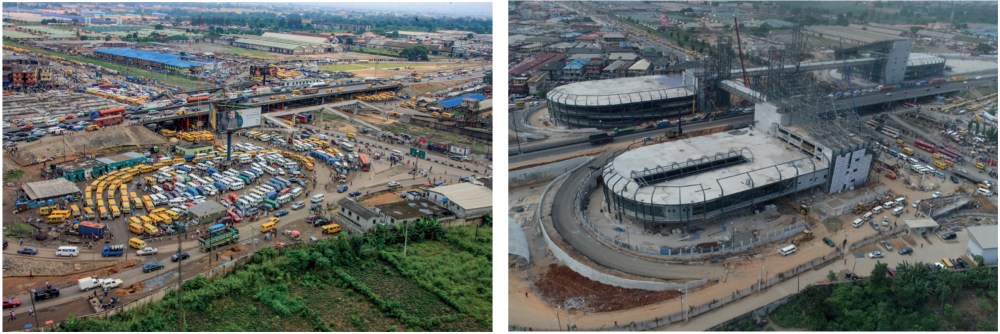
 Urban Transportation Development in Lagos