A light rail network in Lagos could be exactly what the city needs to fix its traffic issues. It’s been projected to reduce travel times 400%, an incredibly significant amount when commutes are currently sitting at anywhere from two to five hours (Salau). The plan that was proposed by the state government in 2003 was actually the second of its kind, as the first was terminated just two years after it started in 1983 (Salau). Cities all over the world, including others in Africa, were developing their rail systems around this time, but Lagos still has no metro line, even though one could do wonders for the city and its traffic problems.
It’s important to look at why these developments are taking so long. The major problem that has become clear is the lack of proper funding and loans, as well as some overambition on the government’s part. The initial plan was large: a seven line network with the focus originally on the Red and Blue lines. But the project was meant to be completed in phases. The first phase of the Blue line was slated to be completed in June 2013, which seemed doable because construction started back in 2008 (Salau). The original deadline wasn’t reached because of issues concerning a World Bank loan that wasn’t approved by the federal government, but even if the funding was secure, a constant moving of goalposts by the government is most of the reason for the seeming lack of progress.
The whole Blue line encompasses the following stops: it “starts at Marina Station, runs on an elevated platform and moves along the National Theatre Station, making a descent at Iganmu Alaba, Mile 2, Festac, Alakija, Trade Fair stations, Volkswagen Station, LASU and finally reaches the Okokomaiko Station” (Salau). The first phase of the project runs between the Marina and Mile 2 stops. This was not always the plan. It was originally to go from National Theatre to Mile 2. The extension of the line to Marina is another reason for the delay. The extension of phase 1 naturally came with an extension of the expected complete date. As of July 2018, the original first section of the line was 98% complete, but the extended first phase was only 60% complete (Salau).
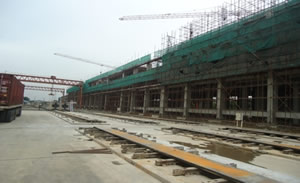
National Theater Station 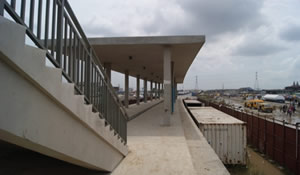
Iganmu Station 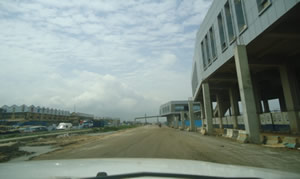
Alaba Station
If the original plan was kept in place, at least some citizens of Lagos would likely have access to the rail line by now, and the public would be more satisfied with tangible progress that has been made. At this point, nothing is available for public use. The change to extend phase 1 was done with good intentions, to make the line useful for more residents. However, even a short rail line would improve the congestion that is present. More of the tangible progress that has been made involves bus transport, but buses just contribute to road congestion, so the only long term solution is a rail line.
 Urban Transportation Development in Lagos